Reading the Body’s Warning Signs: The Multi-System Signature Approach to Hospice Care
Published on
Updated on

Guiding Life's Journey with Care
Guiding Life's Journey with Care
Published on
Updated on
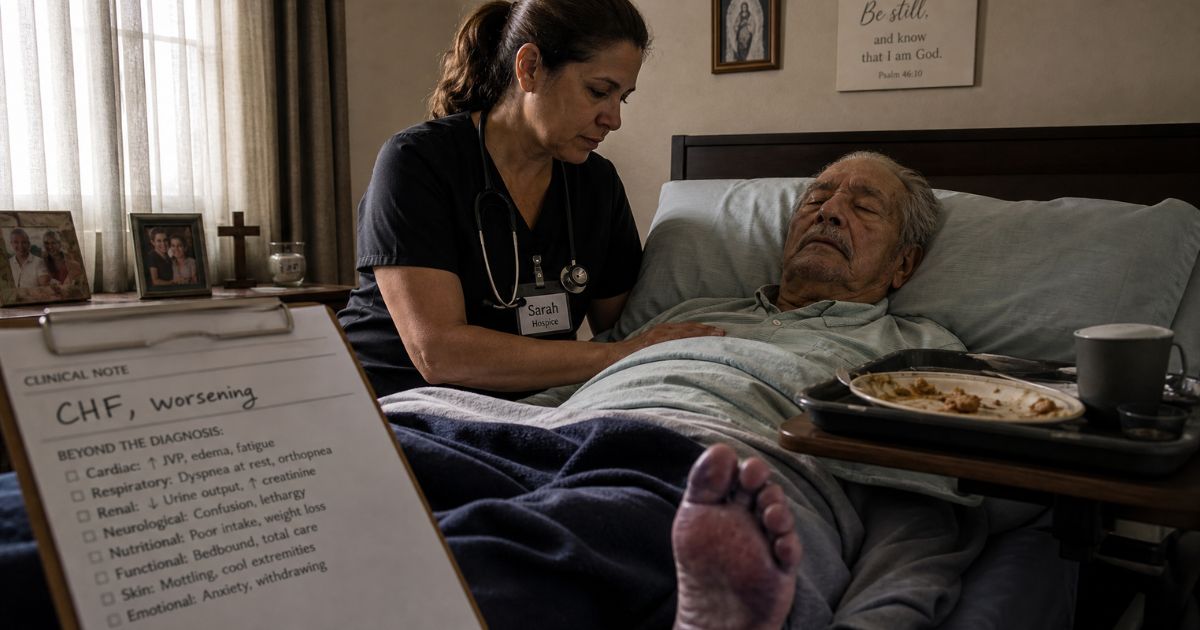
Table of Contents
Sarah checked the chart before her visit. “CHF, worsening,” the last note read. Two words. She walked into Mr. Delgado’s bedroom expecting a tired heart and found something bigger waiting for her.
His feet were mottled purple at the toes. He had not finished a meal in four days. He slept through most of her visit, waking only when she raised her voice near his ear. His breathing caught, paused, then rushed to catch up. None of that showed up in “CHF, worsening.”
Something failed that day, but it was not just his heart. Five systems were breaking down at once, and Sarah almost missed four of them because she was looking for one disease instead of a pattern.
This happens constantly in hospice care. Clinicians open a chart, see a primary diagnosis, and start hunting for that diagnosis to get worse. Heart failure patients get watched for heart failure symptoms. Dementia patients get watched for memory and behavior changes. But bodies do not usually die one organ at a time. They fail together, and reading that combined failure, sometimes called a multi-system signature, changes what a hospice clinician sees, documents, and treats.
Picture the chart tab for a patient with congestive heart failure. Blood pressure trending down. Ejection fraction worse on the last echo. Legs swollen. A clinician glances at those three numbers and writes a note about cardiac decline.
Now picture the same patient in the room. His kidneys are producing less urine each shift. His appetite dropped to almost nothing this week. He needed help turning in bed today, something he managed alone last month. His skin over his heels looks fragile, thin, starting to break down.
The heart is not acting alone. It never was.
Diagnoses like CHF, COPD, dementia, cancer, and Parkinson’s disease name a starting point, not a finish line. Patients rarely die directly from the label on their chart. They die because that original disease drags several other systems down with it, and the real question becomes how many systems are now struggling, not just which one carries the diagnosis.
Think about what a full-body assessment actually looks like when a clinician stops anchoring on one organ.
The heart and vessels show hypotension, a racing pulse, poor circulation, swelling, and skin that mottles at the extremities. The lungs show labored breathing, pauses between breaths, the irregular rise-and-fall pattern called Cheyne-Stokes respirations, rising oxygen needs, and secretions the patient can no longer clear.
The brain and nervous system show confusion that comes and goes, drowsiness that deepens by the week, slower responses to voice and touch, agitation at night that looks like terminal delirium, and eventually an inability to wake at all.
Nutrition and metabolism show a patient eating less, losing muscle, becoming dehydrated, and struggling to swallow safely. Function shows a falling Palliative Performance Scale score: a patient who cannot get out of bed anymore, needs help with everything, and cannot even shift position without assistance.
The kidneys show decreased urine output, darker urine, and rising lab values, even as the patient drinks less. The gut shows trouble swallowing, persistent constipation, and occasional obstruction. The skin shows pressure injuries forming, non-healing tears, and cool patches spreading across the extremities.
Eight systems. Eight sets of clues. A single diagnosis touches one of them. Terminal decline touches several at once, and that difference is the entire point.
Here is a patient nobody would call actively dying from a chart summary alone.
Palliative Performance Scale at 30 percent. Sleeping twenty hours a day. Eating less than a quarter of meals. Aspirating on thin liquids. Blood pressure dropping. Urine output is falling. Feet turning mottled.
Any single finding on that list could mean something minor. A bad week. A medication side effect. Dehydration from the summer heat. Taken alone, none of those seven clues proves death is close.
Put them together, though, and a different picture forms.
Each finding works like a fingerprint left at a scene. One fingerprint tells you almost nothing on its own. Several fingerprints, overlapping and consistent, start to tell a story a trained eye can read. That combined story, that layered pattern across body systems, is the signature clinicians should be hunting for at every visit, not the isolated symptom that happened to show up first.
Compare two hospice notes written about the same visit.
The first reads: “Patient has worsening CHF.” Six words. Technically accurate. Almost useless for supporting eligibility.
The second reads differently: declining cardiac function, worsening renal perfusion, increasing respiratory distress, severe nutritional decline, and profound functional decline, all documented in the same visit note. That second version does something the first cannot. It shows terminal physiology instead of naming a diagnosis and stopping there.
Medicare’s hospice benefit does not require a clinician to name the exact day a patient will die. It asks whether the decline in front of them is progressive, irreversible, and terminal. A single diagnosis label answers none of those three questions by itself. A documented pattern across multiple systems, tracked visit after visit, answers all three at once, and that documentation becomes the backbone of eligibility recertification.
Write what you see across the whole body, not just the system tied to the primary diagnosis.
A patient struggles to breathe. The easy response is to check the oxygen saturation number and adjust the flow rate. Sometimes that is enough. Often it is not, because dyspnea rarely comes from one source.
Heart failure could be driving it. So, it could be COPD, anemia, weak respiratory muscles, aspiration, anxiety, or a shift in blood chemistry called metabolic acidosis. Six possible contributors, sometimes acting together in the same patient on the same day.
Treating only the saturation number ignores the rest. A fuller response addresses air hunger directly, calms anxiety, adjusts positioning, manages secretions, uses opioids appropriately for the sensation of breathlessness, and teaches the caregiver what to watch for overnight.
Agitation works the same way. A restless, distressed patient at 2 a.m. might be dealing with neurologic changes, worsening respiratory distress, a full bladder, constipation, a medication interaction, or unmanaged pain, sometimes two or three of these simultaneously. Chasing a single cause and stopping there leaves the other contributors untreated and the patient still suffering.
Every symptom traces back to a system or several systems interacting at once. The multi-system signature is a reminder to look wider before settling on a single fix.
Picture a patient’s decline stretched across ten weeks.
In week one, only the heart and appetite show trouble. Reduced intake, mild fatigue. Months might still remain, and the clinician documents that honestly. By week five, function has slipped, cognition has dulled, breathing has grown more labored, and nutrition has worsened further. Now, three to five systems are struggling together, and the timeline usually compresses to weeks or a few months rather than a longer stretch.
By week nine, nearly everything has turned. Neurologic responses have dropped off. Breathing has changed character. Kidney output has slowed. The skin shows new breakdown. The gut has stopped tolerating food. Six to eight systems are failing in the same window. Death often becomes a matter of days at that point, not weeks.
This is not a rigid scoring system, and no clinician should treat it as a calculator that spits out an exact countdown. It illustrates something real, though: confidence in a prognosis climbs as the pattern widens, and clinicians who track that widening pattern visit after visit gain a clearer read on timing than those watching a single diagnosis in isolation. Pair this pattern-reading with validated tools already trusted in hospice practice, tools like the Palliative Performance Scale, the FAST scale for dementia staging, and disease-specific Local Coverage Determination criteria, rather than replacing them.
“How is the patient today?” is the question most visits start with, and it is not a bad question. It is simply too narrow to capture a multi-system pattern on its own.
Try scanning the whole body instead. Neuro: better, the same, or worse? Respiratory: better, the same, or worse? Cardiac. Nutrition. Function. Skin. Renal. Run through every system, every visit, marking the direction of change rather than settling for a general impression.
One column marked “worse” might mean nothing. A bad night’s sleep. A skipped meal. Nearly every column marked “worse” tells a much stronger story, and it tells that story regardless of which diagnosis sits at the top of the chart.
This kind of scan takes minutes. It fits inside a normal visit. It builds documentation that actually supports the clinical picture, rather than restating the primary diagnosis in slightly different words each week.
Mrs. Whitfield has advanced Alzheimer’s disease. Her chart names one condition, but her body tells a longer story: barely responsive when spoken to, unable to swallow safely anymore, a recent bout of aspiration pneumonia, a stage IV pressure injury that will not close, kidneys producing less urine each day, completely bedbound, and blood pressure that keeps drifting lower.
She is not dying from Alzheimer’s disease alone. She is dying from a body giving out across seven systems, with dementia as the starting point rather than the whole explanation.
Mr. Alvarez has end-stage heart failure. His ejection fraction keeps falling, and his blood pressure runs low. He struggles to breathe even sitting still. His kidney function has worsened over the past month. He has lost significant muscle mass. He cannot get out of bed without two people helping him. His legs are swollen, and a pressure injury has started forming on his heel.
Two completely different primary diagnoses. Two patients who look nothing alike on paper. The same underlying pattern connects them anyway: a primary disease dragging multiple other systems down with it, and that shared pattern, not the name of either disease, should guide the prognosis conversation for both.
A daughter sits across from a hospice nurse, asking why her father seems to be fading so fast when his heart doctor said his numbers “weren’t that bad” six months ago.
The nurse could explain ejection fraction percentages. Instead, she explains what she has actually watched happen: his breathing working harder each week, his appetite disappearing, his legs swelling more, his mind drifting further from clear conversation, his skin showing new fragility. Several systems are slowing down together, rather than a single number on a single test.
The daughter understands that explanation. It matches what she has watched at her father’s bedside every evening, and it gives her something concrete to hold onto instead of a lab value she cannot picture.
That is what this kind of thinking offers a clinician. Stronger eligibility notes that reflect actual physiology rather than a diagnosis restated weekly. Comfort measures are aimed at the actual causes of a symptom instead of the first cause that comes to mind. Family conversations grounded in what everyone in the room has personally observed. None of it replaces disease-specific guidelines or validated prognostic tools. It sits alongside them, sharpening what a clinician already knows how to do.
Hospice work asks something specific of the clinicians who choose it: stay curious about dying itself, not just about the diseases that lead there.
Bodies do not read textbooks before they fail. They do not organize their decline neatly around a primary diagnosis for a clinician’s convenience. They fail in overlapping, interacting patterns, and the clinicians who learn to read those patterns, system by system, visit by visit, give their patients something real. Stronger documentation that actually supports the care being given. Comfort measures that target true causes instead of surface symptoms. Families who leave conversations with clarity instead of confusion.
Keep studying how the body approaches death. Read the physiology behind the symptoms you already chart every day. Ask what pattern a patient’s body is showing instead of settling for what disease brought them to hospice in the first place.
That habit, carried forward visit after visit, patient after patient, is what turns competent hospice care into care that truly serves the people trusting you with their final months, weeks, or days.
Your Patient Had Four Warning Signs. Your Nurse Saw Zero of Them.
Crisis in Competency: A Defining Moment in Nursing Education
Rapid response systems: a systematic review and meta-analysis
Failure To Rescue – Rapid Response Systems
Multiple organ dysfunction syndrome: Contemporary insights on the clinicopathological spectrum
Approaching Death: Improving Care at the End of Life
How much longer? Articles about hospice prognostication
One-to-One Hospice Nurse Coaching
Self-Paced Hospice Nurse Courses
Digital Downloads for Hospice Teams
The following are hospice-related digital products intended to aid benefit clinicians and agencies:
Empowering Excellence in Hospice: A Nurse’s Toolkit for Best Practices book series
The best symptom management book the author has read: Notes on Symptom Control in Hospice & Palliative Care
Holistic Nurse: Skills for Excellence book series
Articles on Advance Directives
Eldercare Locator: a nationwide service that connects older Americans and their caregivers with trustworthy local support resources
Find the Long-Term Care Ombudsman Program in Your State
Greater National Advocates Directory of Independent Patient Advocates
Patients Voices Matter Foundation – Empowering Patients, Transforming Lives
Independent Patient Advocate – Independent, non-clinical patient advocacy nationwide. Health Navigation, SSDI Application & Appeals, and Whole Health Advocacy. 100% remote. No insurance accepted.
Compassion Crossing, LLC – Independent, clinical patient advocacy nationwide.
Natural Death With Dignity: Protecting Your Right To Refuse Medical Treatment
Beyond the Living Will: Creating Effective Advance Directives and Value-Based Advance Care Planning: A Guide for Helping Professionals
Death and Dying: A Good Exit Plan
Free Daily Symptom Tracker: Each headache, flare, or fatigue spike reveals a clue. This two-page Daily Symptom Tracker records sleep quality, food intake, triggers, severity, and effective relief methods—all in one place. Use it daily for 31 days and share the pages with your healthcare provider or health navigation expert. Together, you can move from guessing to addressing the root cause. Instructions on how to use the free daily symptom tracker and the free daily symptom tracker.
Free Caregiver and Dementia Training Videos
CaringInfo – Caregiver support and much more!
The Hospice Care Plan (guide) and The Hospice Care Plan (video series)
Understanding Palliative Care: A Guide to Common Questions and Answers
Bridging the Gap: Palliative Care’s Role in Supporting Rare Disease Patients
Comprehensive Guide to Financial Assistance for Hospice and Palliative Care Patients
Surviving Caregiving with Dignity, Love, and Kindness
Caregivers.com | Simplifying the Search for In-Home Care
Geri-Gadgets – Washable, sensory tools that calm, focus, and connect—at any age, in any setting
Healing Through Grief and Loss: A Christian Journey of Integration and Recovery
This site uses Amazon Associate links, which means I earn a small commission when you purchase books or products through these links—at no extra cost to you. These earnings help me keep this website running and ad-free, so I can continue providing helpful articles and resources at no charge.
If you don’t see anything you need today but still want to support this work, you can buy me a cup of coffee or tea. Every bit of support helps me continue writing and sharing resources for families during difficult times.
VSED Support: What Friends and Family Need to Know
Take Back Your Life: A Caregiver’s Guide to Finding Freedom in the Midst of Overwhelm
The Conscious Caregiver: A Mindful Approach to Caring for Your Loved One Without Losing Yourself
Everything Happens for a Reason: And Other Lies I’ve Loved
Final Gifts: Understanding the Special Awareness, Needs, and Communications of the Dying