Choosing the Right Tool: How the Beers Criteria, STOPPFrail, and STOPP/START Guide Safer Medication Decisions in Hospice
Published on
Updated on

Guiding Life's Journey with Care
Guiding Life's Journey with Care
Published on
Updated on

Table of Contents
Maria had been living with end-stage heart failure and moderate dementia for two years. When she was admitted to hospice, her medication list had 16 entries. Statins. A bone density pill. A blood pressure medication from a regimen started when she was 60 and healthy enough to garden every afternoon. A pill to manage a blood sugar level that no one had checked in months. Her hospice nurse, Teri, sat with that list for a long time. Not because she didn’t know what to do, but because she did: she knew she couldn’t do anything alone. What she needed was a systematic way to flag medications that might no longer serve Maria’s comfort, bring that information to the interdisciplinary team, and then have an honest, respectful conversation with Maria’s daughter, who held medical power of attorney.
That process — methodical, ethical, and centered on the patient — is exactly what medication screening tools are designed to support. The Beers Criteria, STOPPFrail, and STOPP/START are three of the most widely used. Each was designed with a different patient in mind. Understanding what each tool does well, where its limits are, and when to reach for it will make you a more effective advocate for the people in your care.
Deprescribing means intentionally reducing, stopping, or tapering a medication when the risks of continuing it outweigh the benefits for that specific patient at that specific point in their life. It is not neglect. It is a deliberate, evidence-informed clinical process.
In hospice, goals of care shift fundamentally. Medications prescribed to prevent a heart attack five years from now, slow bone loss over a decade, or maintain a hemoglobin A1c within a target range carry little meaning for a person whose life expectancy is measured in weeks or months. What matters is comfort, dignity, and quality of life right now. Continuing medications that no longer align with those goals can cause side effects, increase pill burden, and create unnecessary distress for patients and families. In some cases, the medications themselves become the source of suffering.
Deprescribing in hospice is an act of clinical precision and compassion in equal measure.
The American Geriatrics Society (AGS) Beers Criteria is a list of potentially inappropriate medications (PIMs) for adults aged 65 and older. First published in 1991 by Dr. Mark Beers, it has been updated several times, with the most recent version released in 2023. It is organized into five categories: medications to avoid in most older adults, medications to avoid in older adults with specific diseases or conditions, medications to use with caution, drug-drug interactions to avoid, and medications requiring dose adjustments based on kidney function.
The Beers Criteria is thorough. It draws on robust evidence and expert consensus, and it is widely recognized across care settings.
Here is something the Beers Criteria itself states plainly: it is intended for use in ambulatory, acute care, and institutionalized settings — and it explicitly excludes hospice and end-of-life care settings from its intended scope. That exclusion is not incidental. It reflects the reality that comfort-centered care operates under a completely different set of clinical priorities.
Consider what happens when a hospice nurse applies the Beers list without recognizing this. A patient in the final weeks of life is on a low-dose benzodiazepine that has been managing her anxiety and air hunger for months. The Beers Criteria flags it as potentially inappropriate. A well-intentioned but poorly informed clinician moves to discontinue it. The patient’s anxiety worsens. Her family, who watched her finally find peace, is now watching her suffer again.
That scenario is not hypothetical. It happens when tools are applied outside their intended context. The Beers Criteria were not built for Maria. It was built for the 72-year-old man who walks into a primary care office for a routine visit.
That said, the Beers list retains real value in hospice — specifically at the point of admission. When a patient arrives with a long medication list from an acute care facility, the Beers Criteria serves as a solid first-pass screening tool that can rapidly flag medications requiring closer review before a more hospice-specific tool is applied. Use it to identify what needs deeper review, then hand the work off to a tool designed for the frail, end-of-life patient.
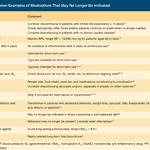
STOPPFrail — short for Screening Tool of Older Persons’ Prescriptions in Frail adults with limited life expectancy — was developed specifically for frail older adults approaching the end of life. It contains 27 criteria and applies to patients who meet all four of the following conditions:
That last criterion is worth pausing on. STOPPFrail does not ask, “Is this medication potentially dangerous for older adults?” It asks, “Does this medication still serve this patient’s goal of comfort?” That is a fundamentally different question — and it is the right one for hospice.
David, an 84-year-old man with end-stage COPD and mild vascular dementia, was admitted to hospice on nine medications. His hospice nurse, Jerome, used STOPPFrail during the initial medication review.
Three medications appeared on STOPPFrail’s list of potentially inappropriate prescriptions: a statin for cholesterol management, a bisphosphonate for osteoporosis prevention, and a low-dose aspirin with no clear symptom-management purpose. None of these medications controlled a symptom that David could feel. All three carried risk — muscle pain, gastrointestinal upset, and bleeding risk, respectively — without offering a benefit that David would live long enough to experience.
Jerome documented his findings and brought them to the next IDT meeting. The medical director reviewed the STOPPFrail findings and agreed. Before any changes were made to David’s regimen, the team scheduled a care conference with David’s son, who held medical power of attorney. The son asked questions. He was given time. All three medications were stopped, and David told his son he felt “lighter” that week. Nothing changed without permission. That is the standard.
STOPPFrail was not designed as a general geriatric screening tool. It was designed for people who are exactly where hospice patients are: at the end of a serious, irreversible illness, where comfort is the north star. Its 27 criteria are lean and purposeful. They do not overreach. And they consistently ask whether continuing a medication is justified, given that this patient likely has less than a year to live.
For the classic hospice patient — frail, multi-morbid, functional decline, advanced — STOPPFrail is the tool most tightly aligned with the hospice mission.
STOPP/START is a two-part tool, and that structure is what sets it apart from both Beers and STOPPFrail. STOPP (Screening Tool of Older Persons’ Prescriptions) identifies medications that may be discontinued. START (Screening Tool to Alert to Right Treatment) identifies medications that may be missing — ones the patient should potentially be on, given their diagnoses and condition. Together, they catch both over- and under-prescribing.
Under-prescribing is a real and underappreciated problem in hospice. A patient might be on too many disease-prevention medications and simultaneously be missing a bowel regimen, an antiemetic, or a comfort-targeted medication that could meaningfully reduce suffering.
Ruth, a 78-year-old woman with advanced ovarian cancer, had been on scheduled opioids for three weeks. Her hospice nurse noticed she had not had a bowel movement in eight days. Her medication reconciliation form showed no standing laxative or bowel regimen of any kind.
The START component of STOPP/START flags exactly this type of omission. Patients on regular opioids need a proactive bowel regimen — not a “wait and see” approach. Ruth’s nurse brought this to the IDT. The medical director ordered a scheduled osmotic laxative and a rescue suppository as needed. The family spokesperson confirmed Ruth would want this addressed. Within 72 hours, Ruth’s comfort improved significantly.
That gap — a missing medication — would not have been caught by Beers or STOPPFrail.
STOPP/START Version 3, validated through a rigorous Delphi consensus process involving an international panel of experts, now includes 114 criteria total: 80 STOPP criteria and 34 START criteria. Version 3 expanded the scope of both components, improved specificity, and updated criteria to reflect current evidence. If your team is using an earlier version, update your reference materials now.
STOPP/START is best suited for patients who are earlier in their hospice trajectory and remain relatively functional, as well as for patients with complex multimorbid conditions in which both stopping and starting medications require careful simultaneous analysis. It adds the most value when a pharmacist or medical director is actively co-reviewing the medication list with the nursing team, and when there is reason to believe under-prescribing is a concern alongside polypharmacy.
No hospice team member — nurse, medical director, social worker, or pharmacist — ever independently deprescribes or initiates a new medication without documented permission from the medical power of attorney (MPOA), family spokesperson, or legal guardian. Full stop.
The only exception is temporarily holding a medication in a genuine emergency to prevent immediate harm — for example, holding an insulin dose when a patient is unresponsive and unable to eat. Even then, that decision must be documented in real time, communicated to the team, and reported to the MPOA or family spokesperson as soon as possible. “Emergency hold” is a narrow, documented exception, not a workaround.
This standard is not a formality. It is the foundation of trust in the hospice relationship. Families have entrusted their loved ones to your care. The MPOA carries a legal and moral authority that must be honored at every step of the medication decision process.
Sharon’s hospice nurse completed a STOPPFrail review during a 30-day visit and identified four medications that appeared to no longer align with Sharon’s comfort goals: a cholesterol medication, a blood pressure medication now causing dizziness and increasing fall risk, an antidiabetic agent for a blood sugar level that no longer required tight control, and a weekly supplement with no symptom benefit.
The nurse documented her clinical reasoning for each one and brought the review to the IDT meeting. The medical director agreed that all four warranted discussion. A care conference was scheduled.
Sharon’s husband, who held MPOA, sat at the table. The nurse explained each medication in plain language — what it was for, why it may no longer serve Sharon’s comfort, and what stopping it would and would not change. He asked whether stopping the blood pressure medication could cause Sharon’s blood pressure to spike suddenly. The nurse answered honestly: yes, it could, and the team would monitor closely. He agreed to stop two medications immediately and asked to wait two weeks on the other two.
Two were stopped. Two stayed. All of it was documented. All of it was his decision to make.
That is what ethical deprescribing looks like.
Before reaching for a screening tool, ask yourself two questions: Where is this patient in their hospice trajectory? And what is the primary concern — too many medications, a missing medication, or both?
Use Beers when the patient has just been admitted from acute care, and you need a rapid first-pass flag of high-risk medications before a more targeted review.
Use STOPPFrail when the patient fits the frail, end-of-life profile — advanced irreversible disease, poor prognosis, comfort-only goals, significant functional or cognitive decline — and the central question is whether existing medications still justify their risk.
Use STOPP/START when the patient is earlier in their hospice course, has layered multi-morbid conditions, or when there is reason to believe medications may be missing as well as excessive.
These tools are not in competition. A thorough hospice medication review might start with a Beers pass at admission, move to STOPPFrail as decline progresses, and reach for STOPP/START when the clinical picture becomes more complex. Use them together, sequentially and intentionally, always with ethics and the patient’s voice at the center.
The patients you serve at the end of life deserve the most skilled, knowledgeable, and ethically grounded version of you. Medication reconciliation and deprescribing are not peripheral competencies. They are central to comfort-centered care, and they require ongoing learning.
If you want to go deeper, these resources were written specifically with hospice professionals in mind:
Every hospice professional has the capacity to become more confident and more competent in medication review. The tools exist. The resources exist. Your patients are counting on you to use them.
Understanding the Beers Criteria Is Essential
Beers Criteria for Potentially Inappropriate Medication Use in Older Adults
The basics of the STOPP/START criteria
Implementing the STOPP/START criteria to prevent polypharmacy in older adults
One-to-One Hospice Nurse Coaching
Self-Paced Hospice Nurse Courses
Digital Downloads for Hospice Teams
The following are hospice-related digital products intended to aid benefit clinicians and agencies:
Empowering Excellence in Hospice: A Nurse’s Toolkit for Best Practices book series
The best symptom management book the author has read: Notes on Symptom Control in Hospice & Palliative Care
Holistic Nurse: Skills for Excellence book series
Articles on Advance Directives
Eldercare Locator: a nationwide service that connects older Americans and their caregivers with trustworthy local support resources
Find the Long-Term Care Ombudsman Program in Your State
Greater National Advocates Directory of Independent Patient Advocates
Patients Voices Matter Foundation – Empowering Patients, Transforming Lives
Independent Patient Advocate – Independent, non-clinical patient advocacy nationwide. Health Navigation, SSDI Application & Appeals, and Whole Health Advocacy. 100% remote. No insurance accepted.
Compassion Crossing, LLC – Independent, clinical patient advocacy nationwide.
Natural Death With Dignity: Protecting Your Right To Refuse Medical Treatment
Beyond the Living Will: Creating Effective Advance Directives and Value-Based Advance Care Planning: A Guide for Helping Professionals
Death and Dying: A Good Exit Plan
Free Daily Symptom Tracker: Each headache, flare, or fatigue spike reveals a clue. This two-page Daily Symptom Tracker records sleep quality, food intake, triggers, severity, and effective relief methods—all in one place. Use it daily for 31 days and share the pages with your healthcare provider or health navigation expert. Together, you can move from guessing to addressing the root cause. Instructions on how to use the free daily symptom tracker and the free daily symptom tracker.
Free Caregiver and Dementia Training Videos
CaringInfo – Caregiver support and much more!
The Hospice Care Plan (guide) and The Hospice Care Plan (video series)
Understanding Palliative Care: A Guide to Common Questions and Answers
Bridging the Gap: Palliative Care’s Role in Supporting Rare Disease Patients
Comprehensive Guide to Financial Assistance for Hospice and Palliative Care Patients
Surviving Caregiving with Dignity, Love, and Kindness
Caregivers.com | Simplifying the Search for In-Home Care
Geri-Gadgets – Washable, sensory tools that calm, focus, and connect—at any age, in any setting
Healing Through Grief and Loss: A Christian Journey of Integration and Recovery
This site uses Amazon Associate links, which means I earn a small commission when you purchase books or products through these links—at no extra cost to you. These earnings help me keep this website running and ad-free, so I can continue providing helpful articles and resources at no charge.
If you don’t see anything you need today but still want to support this work, you can buy me a cup of coffee or tea. Every bit of support helps me continue writing and sharing resources for families during difficult times.
VSED Support: What Friends and Family Need to Know
Take Back Your Life: A Caregiver’s Guide to Finding Freedom in the Midst of Overwhelm
The Conscious Caregiver: A Mindful Approach to Caring for Your Loved One Without Losing Yourself
Everything Happens for a Reason: And Other Lies I’ve Loved
Final Gifts: Understanding the Special Awareness, Needs, and Communications of the Dying