Why Turning 50 Shouldn’t Be Your Advance Care Planning Deadline
Published on
Updated on

Guiding Life's Journey with Care
Guiding Life's Journey with Care
Published on
Updated on
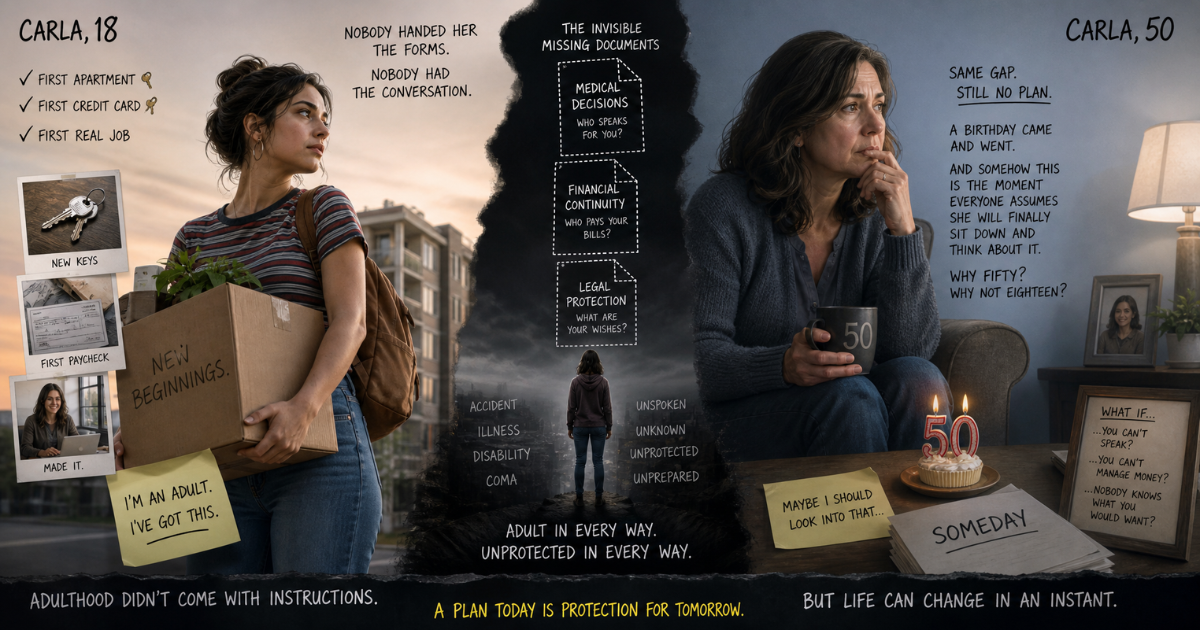
Table of Contents
Picture a woman named Carla. She just turned eighteen. She got her first apartment, her first credit card, and her first real job. Nobody handed her a form asking what she wants done if a car accident leaves her unable to speak for herself. Nobody mentioned a document that names who pays her rent if she is in a coma for six weeks. She is an adult now. Legally, medically, financially. And legally, medically, and financially, she is unprotected.
Now picture her again at fifty. Same gap. Still no plan. A birthday came and went, and somehow this is the moment everyone assumes she will finally sit down and think about it. Why fifty? Why not eighteen, when she first became responsible for her own body and her own money? This article walks through why the starting line for advance care planning has nothing to do with a milestone birthday, what a real plan actually contains, and why the way you build that plan matters just as much as building it at all.
Turning eighteen changes almost everything about how the law sees you. You can vote. You can sign a lease. You can be sued. You can also be intubated, sedated, and kept alive on machines with no one legally authorized to speak for you, unless you have already said who that person is.
A car crash does not check your driver’s license for age before it happens. Neither does a stroke, a severe allergic reaction, or a bad reaction to anesthesia during a routine surgery. Young adults end up in intensive care units every day, and many of them have never had a single conversation about what they would want if they could not answer for themselves.
Waiting until fifty, or sixty, or “when I’m older” treats advance care planning like a retirement account you can start funding later without much loss. It is not. It is closer to a seatbelt. You do not wait until you feel like you are about to crash.
A real advance care plan is not one document. It is a small set of tools that work together, each covering a different kind of decision you cannot make yourself once you are incapacitated.
This document, sometimes called a living will, names a person, your healthcare surrogate, who can speak to your doctors when you cannot. It should also describe what you actually want: comfort-focused care, aggressive treatment, or something in between, depending on your prognosis. Without it, a hospital may turn to a default hierarchy set by state law, and the person making decisions for you might be someone you would not have picked yourself, working from guesses instead of your own words.
While the medical side gets most of the attention, bills do not pause because you are unconscious. A durable financial power of attorney names someone who can pay your mortgage, manage your bank accounts, and keep your finances from collapsing while you are unable to handle them. Skip this piece, and your family may need to go to court just to keep your lights on.
Ask four different people how to create an advance directive, and you will likely get four different answers, but most of those answers cluster into a few recognizable camps.
You are admitted for a hip replacement. Somewhere between the intake paperwork and the wristband, someone slides you a form with four yes-no questions. Do you want your life prolonged? Do you want artificial hydration and nutrition? Do you want antibiotics at the end of life? Do you want to donate your organs? You check a box, sign, and move on with your day.
This form exists because federal law requires hospitals to ask about advance directives. It takes two minutes to complete. It also captures almost nothing about why you feel the way you do, what quality of life means to you, or how your answer might change depending on your diagnosis and prognosis.
An elder law attorney, or really any attorney drafting estate documents, does one thing well. They name a person and give that person the power. Full authority, on paper, ready to use the moment you cannot speak for yourself. The document is airtight. It holds up in court. It does exactly what it was built to do.
Here is the part it does not do. It does not teach your surrogate a single thing about medicine.
Your daughter, your husband, your best friend from college, whoever you named, now holds full legal power to make decisions about ventilators, feeding tubes, and resuscitation. They are not a doctor. They have almost certainly never sat through a code, never watched what a ventilator actually looks like on a person who does not want it, never had to weigh survival odds against suffering. Power on paper does not come with a medical degree attached.
So what happens when a physician turns to that surrogate in a hospital hallway and asks whether to continue aggressive treatment? Nearly every time, the surrogate looks to the doctor for the answer, because the surrogate has no idea what you would have wanted and no training to evaluate the medical trade-offs being described to them in the moment. They default to whatever the doctor recommends. The doctor, trained to treat and to fight for survival, tends to recommend more treatment. More scans, more procedures, more days in the intensive care unit. The surrogate says yes because saying no feels like giving up on someone they love, and they were never handed the tools to say anything else.
This is how full legal authority turns into overtreatment. Not through malice. Through a gap nobody filled.
Then there is a smaller group of people, advance care planning specialists, who sit with you for an hour, sometimes longer, and ask questions that go past the checkbox. What does a good day look like to you right now? What would make you say enough is enough? Would you want a feeding tube if you could no longer recognize your own children? How do your faith or your family history shape what “quality of life” even means for you?
Compassion Crossing built its ten-page Value-Based Kentucky Medical Living Will around exactly this kind of conversation. For people living outside Kentucky, Compassion Crossing also offers value-expression forms designed to capture the same depth of thought while adapting to different state requirements. These documents do not replace the legal authority piece. They build a foundation underneath it.
Here is the honest comparison. All three approaches are better than having nothing at all. A checkbox form is still a legal document. An attorney-drafted power of attorney still names someone with real authority. Doing something is always better than doing nothing.
But only the value-based, specialist-guided approach reliably protects you from unwanted treatment while also protecting the person you named to speak for you.
Nearly a quarter of older adults report that they or a family member with advanced illness was pushed into unwanted or excessive treatment [web:44]. Physicians themselves estimate that a meaningful share of overall medical care, a median of roughly one-fifth, is unnecessary, often driven by fear of liability and pressure from patients or families rather than by what the patient would have actually chosen. A four-question checkbox form cannot prevent this. It answers broad categories but leaves the gray areas, and end-of-life care is almost entirely gray, completely undefined.
The attorney-drafted power of attorney has a different problem. It hands your surrogate the authority to decide, but authority without guidance is a heavy thing to carry. Imagine being told you can choose whether to continue your mother’s ventilator, with full legal power to do so, and no idea whether she would have wanted that. That is not empowerment. That is pressure dressed up as trust. A value-based plan removes that weight by making the decision, in large part, already made. The surrogate is not guessing anymore. They are following instructions their loved one thought through carefully, in advance, on a good day, with a clear head.
A specialist does not rush you through a form. They sit across from you or join you on a video call and ask what matters. They talk through scenarios most people have never considered: What if you had a stroke and could understand people but could not speak? What if a cure existed, but the treatment itself would leave you in constant pain for the rest of your life? They write down your answers in language specific enough that a doctor reading it during a crisis knows what to do next.
This process usually takes longer than a hospital intake form. It should. A plan built in ten minutes is a plan built for the paperwork, not for you. A plan built over an hour, sometimes across several visits, becomes something a healthcare team can actually use as the foundation for your plan of care, honoring both your refusals and your preferences instead of leaving them open to interpretation.
The specialist also revisits the plan as your life changes. A diagnosis, a divorce, a new grandchild — any of these can shift what you would want. A checkbox form gathering dust in a filing cabinet does not update itself. A relationship with a specialist does.
Carla, the eighteen-year-old from the beginning of this piece, does not need to wait until fifty. Neither do you, whatever your age is right now. The best time to build a value-based advance care plan is before a crisis forces the conversation, when you can think clearly, talk it through with the people who love you, and put your own words down instead of someone else’s checkboxes.
If you do not yet have a plan built around your values, find a local advance care planning specialist. If you are not sure where to look or want help sorting out what a good plan actually contains, book a free consultation with Compassion Crossing, LLC. You do not need a birthday to start. You just need to start.
Reflections on Turning 50: Time for an Advance Care Plan
Lack of advance directives leads to unwanted care
You Will Not Be the Person Who Filled Out That Form
Overtreatment in the United States
Compassion Crossing Advance Care Planning Articles
Articles on Advance Directives
Eldercare Locator: a nationwide service that connects older Americans and their caregivers with trustworthy local support resources
Find the Long-Term Care Ombudsman Program in Your State
Greater National Advocates Directory of Independent Patient Advocates
Patients Voices Matter Foundation – Empowering Patients, Transforming Lives
Independent Patient Advocate – Independent, non-clinical patient advocacy nationwide. Health Navigation, SSDI Application & Appeals, and Whole Health Advocacy. 100% remote. No insurance accepted.
Compassion Crossing, LLC – Independent, clinical patient advocacy nationwide.
Natural Death With Dignity: Protecting Your Right To Refuse Medical Treatment
Beyond the Living Will: Creating Effective Advance Directives and Value-Based Advance Care Planning: A Guide for Helping Professionals
Death and Dying: A Good Exit Plan
Free Daily Symptom Tracker: Each headache, flare, or fatigue spike reveals a clue. This two-page Daily Symptom Tracker records sleep quality, food intake, triggers, severity, and effective relief methods—all in one place. Use it daily for 31 days and share the pages with your healthcare provider or health navigation expert. Together, you can move from guessing to addressing the root cause. Instructions on how to use the free daily symptom tracker and the free daily symptom tracker.
Free Caregiver and Dementia Training Videos
CaringInfo – Caregiver support and much more!
The Hospice Care Plan (guide) and The Hospice Care Plan (video series)
Understanding Palliative Care: A Guide to Common Questions and Answers
Bridging the Gap: Palliative Care’s Role in Supporting Rare Disease Patients
Comprehensive Guide to Financial Assistance for Hospice and Palliative Care Patients
Surviving Caregiving with Dignity, Love, and Kindness
Caregivers.com | Simplifying the Search for In-Home Care
Geri-Gadgets – Washable, sensory tools that calm, focus, and connect—at any age, in any setting
Healing Through Grief and Loss: A Christian Journey of Integration and Recovery
This site uses Amazon Associate links, which means I earn a small commission when you purchase books or products through these links—at no extra cost to you. These earnings help me keep this website running and ad-free, so I can continue providing helpful articles and resources at no charge.
If you don’t see anything you need today but still want to support this work, you can buy me a cup of coffee or tea. Every bit of support helps me continue writing and sharing resources for families during difficult times.
VSED Support: What Friends and Family Need to Know
Take Back Your Life: A Caregiver’s Guide to Finding Freedom in the Midst of Overwhelm
The Conscious Caregiver: A Mindful Approach to Caring for Your Loved One Without Losing Yourself
Everything Happens for a Reason: And Other Lies I’ve Loved
Final Gifts: Understanding the Special Awareness, Needs, and Communications of the Dying


